When people hear terms like “STD” and “STI,” they often assume they mean the same thing. In everyday conversation, they’re used interchangeably, but there’s actually an important distinction between the two.
Understanding that difference isn’t just about terminology, it directly affects how we think about testing, prevention, and even relationships.
Let’s break it down in a simple, real-world way so you can walk away with clarity, not confusion.
Understanding the Basics
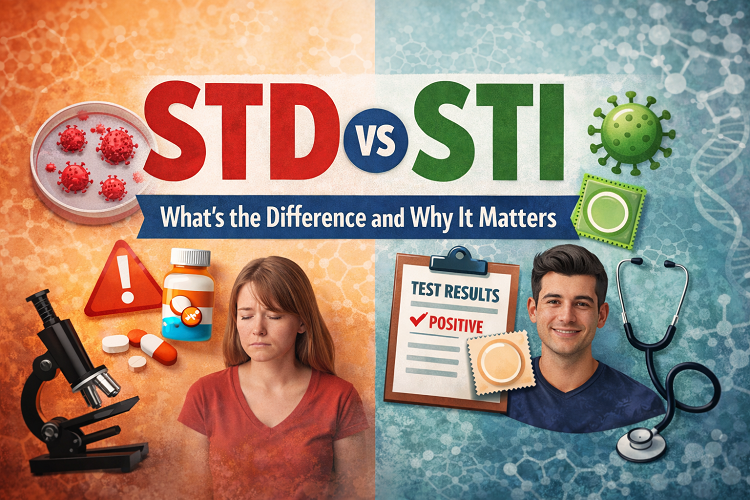
At the core, both terms refer to infections passed primarily through sexual contact. But the key difference lies in when symptoms appear or if they appear at all.
An STI (Sexually Transmitted Infection) means a virus, bacteria, or parasite has entered the body. At this stage, there may be no visible symptoms. A person can feel completely healthy and still carry and transmit the infection.
An STD (Sexually Transmitted Disease) develops when that infection begins causing symptoms or complications. This could include pain, discharge, sores, or more serious long-term health issues.
Think of it this way: every STD starts as an STI, but not every STI turns into an STD.
Why the Difference Actually Matters
This isn’t just medical wording—it changes how people approach their health.
Many people avoid testing because they feel fine. The assumption is simple: “If I don’t have symptoms, I must be okay.” But that’s exactly where the misunderstanding of STI vs STD becomes risky.
A large number of infections, including common ones like HPV or herpes, can stay silent for long periods. During that time, they can still be passed to others.
Understanding this difference encourages regular testing, even when nothing feels wrong. It shifts the mindset from reactive (“I’ll test if I have symptoms”) to proactive (“I’ll test to stay informed and responsible”).
Real-Life Perspective (Experience-Based Insight)
In real-world dating and health conversations, this confusion shows up more often than people realize.
Many individuals only discover an infection during routine screening, pregnancy checkups, or when a partner tests positive. That moment can be surprising, especially when there were no signs at all.
People who regularly get tested often say the same thing: it’s less about fear and more about peace of mind. Knowing your status removes uncertainty and helps you make better decisions, whether you’re single, dating, or in a long-term relationship.
How Medical Experts View It
Healthcare professionals increasingly prefer the term “STI” because it’s more accurate and less stigmatizing. It focuses on the presence of an infection rather than implying illness or visible disease.
This shift also helps normalize testing. When people hear “disease,” it can feel intimidating or alarming. “Infection” feels more clinical and manageable, which encourages more people to get checked without fear or shame.
Doctors emphasize that early detection of an STI can prevent it from becoming an STD. In many cases, timely treatment can stop complications entirely.
Common Examples to Make It Clear
Let’s look at a simple scenario.
A person contracts a viral infection through sexual contact but has no symptoms. That’s an STI. Months later, they begin experiencing discomfort or visible signs. At that point, it may be classified as an STD.
Another example is HPV. Many people carry it without ever knowing. In most cases, it never develops into anything serious, but in some cases, it can lead to health complications over time.
The key takeaway is this: absence of symptoms does not mean absence of infection.
The Role of Testing
Testing plays a central role in bridging the gap between STI and STD awareness.
Regular screening helps detect infections early, often before they cause symptoms. This allows for early treatment, reduces transmission, and protects both partners in a relationship.
Many people delay testing because of embarrassment or fear of results. But in reality, testing is one of the most responsible and empowering things a person can do for their health.
It’s not about judgment—it’s about awareness.
Community Insights (What People Are Saying)
Across health forums, support groups, and online communities, a common theme keeps coming up: education changes everything.
Some share that they avoided testing for years because they felt fine. Others mention that open conversations with partners became easier once they understood that infections can exist without symptoms.
There’s also a growing movement of people encouraging honest discussions in relationships. Instead of treating sexual health as a taboo topic, more individuals are choosing transparency and responsibility.
That shift is making a real difference.
Emotional and Relationship Impact
The way we understand STIs and STDs also affects relationships.
When people assume symptoms are always present, they may wrongly blame partners or jump to conclusions. This can lead to unnecessary conflict or mistrust.
A better understanding helps create more balanced conversations. It allows partners to approach the topic calmly, focusing on health rather than assumptions.
Open communication builds trust. And trust is always stronger when it’s backed by knowledge.
Prevention Still Matters
While understanding the difference is important, prevention remains the foundation of sexual health.
Using protection, limiting risk factors, and getting regular checkups all play a role in reducing the chances of infection. No method is perfect, but awareness combined with responsible choices significantly lowers risk.
Prevention isn’t about fear, it’s about staying informed and prepared.
Expert Takeaway (Authoritativeness)
Medical guidelines worldwide continue to stress the importance of routine STI screening, especially for sexually active individuals. Early detection is one of the most effective ways to prevent complications.
Healthcare professionals also highlight that stigma is one of the biggest barriers to testing. The more people understand that infections can exist without symptoms, the more likely they are to take proactive steps.
Knowledge leads to action and action leads to better health outcomes.
Trust and Transparency
Trustworthiness in sexual health comes down to honest information and responsible behavior.
Whether it’s getting tested, sharing results with a partner, or simply educating yourself, each step contributes to a healthier environment for everyone.
The goal isn’t perfection. It’s awareness and consistency.
FAQs
What is the main difference between an STI and an STD?
An STI refers to an infection that may not have symptoms, while an STD occurs when that infection leads to noticeable symptoms or health issues.
Can you have an STI without knowing it?
Yes, many infections remain asymptomatic for long periods, which is why regular testing is important.
Should I get tested even if I feel fine?
Absolutely. Feeling fine doesn’t guarantee that you’re infection-free.
Are STIs treatable?
Many are treatable, and some are curable. Early detection makes a big difference in outcomes.
How often should I get tested?
It depends on your lifestyle and risk factors, but routine screening is recommended for sexually active individuals.
Real Stories (Anonymized Testimonials)
“I always thought no symptoms meant no problem. Getting tested changed that mindset completely. It gave me clarity and confidence moving forward.” — A., 28
“I was nervous about testing for years. Once I finally did it, I realized it wasn’t as scary as I thought. Now it’s just part of my routine.” — R., 34
“My partner and I had an honest conversation about testing early on. It actually brought us closer because we trusted each other more.” — K., 26
“I learned the difference between STI and STD through a community group. That knowledge made me take my health more seriously.” — S., 31
Final Thoughts
Understanding the difference between STD and STI isn’t just about terminology, it’s about changing how we approach health, relationships, and responsibility.
When people realize that infections can exist silently, they become more proactive. They test more regularly, communicate more openly, and make more informed decisions.
That shift doesn’t just protect individuals, it strengthens communities.
At the end of the day, awareness is powerful. And when awareness leads to action, everyone benefits.